Two programs, one acronym soup
The IRA's Home Energy Rebates created two distinct programs under Sections 50121 and 50122, and they work very differently even though homeowners often hear about both in the same breath.
HOMES (Home Efficiency Rebates)
Performance-based. HOMES rewards whole-home energy savings rather than specific equipment — the rebate amount scales with modeled or measured reduction in energy use, typically stepping up at 20% and 35% savings thresholds. A heat pump replacing a furnace can qualify, but so can insulation, air sealing, or a combination of measures, as long as the modeled savings clear the bar (Energy-Models.com).
HEAR / HEEHRA (Home Electrification and Appliance Rebates)
Equipment-based and income-tiered. HEAR funds specific electrification upgrades — heat pumps, heat pump water heaters, electric panels, wiring, insulation, and electric cooking equipment — with rebate amounts set by income, not by measured savings. Households at or below 80% of area median income (AMI) can have up to 100% of project costs covered; households between 80% and 150% AMI get roughly 50% coverage; above 150% AMI, most states don't fund the program at all. The federal cap is $14,000 per household ($8,000 for the heat pump itself, plus smaller caps for a water heater, panel, wiring, insulation, and stove or dryer) (TECH Clean California; RMI).
Key difference: HOMES pays for the outcome (energy saved); HEAR pays for the equipment (and is means-tested). A single project can sometimes draw from both, but few states have finished building the paperwork to let homeowners stack them cleanly yet.
Why the map looks like a patchwork
Congress funded both programs at the federal level, but each state's energy office has to design its own application process, hire staff or contractors to run it, and get its plan approved by the DOE before a single rebate goes out. That means identical projects in two different states can land very different outcomes — one homeowner gets a live rebate check, another in a neighboring state is still waiting on a program that was "approved" a year ago but never opened for applications.
The map below, from energy-modeling firm Energy-Models.com, tracks the 25 states with the most active programs (the other 25 remain gray — either no program submitted yet, or funding declined) by status, maximum rebate amount, and program "opportunity" — a composite of rebate size, multifamily eligibility, and how well energy modeling can help a project reach a higher tier.
Map · HOMES and HEAR rebates by top 25 states
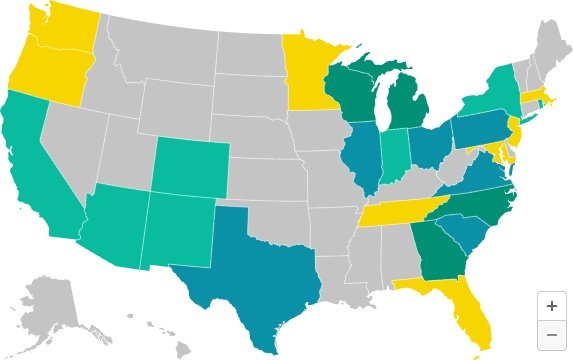
A few things stand out in that dataset. Michigan and Massachusetts show the largest combined ceiling — up to $20,000 in HOMES on top of the $14,000 HEAR cap. New York, Tennessee, and Rhode Island aren't far behind at $16,000 in HOMES. Program status varies just as much as the dollar amounts: Energy-Models.com's own status legend runs from "Live" (accepting applications) through "Live (Partial)," "Approved" (DOE-approved plan, program not fully open), and "Submitted" (plan filed, awaiting DOE sign-off) — and reading the status column matters as much as the rebate ceiling, since an "Approved" program on paper can still mean nothing is actually payable yet.
Cross-checking the count: trackers don't agree, and that's normal
Because every state office publishes its own updates on its own schedule, no two third-party trackers report the identical launch count on the same day. As of July 25, 2026, the Home Energy Rebate Finder counted 27 states with HOMES and/or HEAR launched, 22 states still preparing to launch, and 2 states — Idaho and South Dakota — that declined the funding outright. A separate tracker, WattRebate, counted only 14 states as fully "live" as of August 4, 2026, with 34 still preparing — a meaningfully different picture from the same underlying programs, most likely reflecting a stricter definition of "live" (fully processing applications) versus a looser one (any funding milestone hit).
The practical takeaway: treat every published count, including the map above, as a snapshot with its own definition of "launched," not a settled fact. The Rebate Map, a live-updated dashboard, is a useful third cross-check — it flagged Colorado's HEAR allocation as fully exhausted ($0 remaining) as of August 3, 2026, a level of granularity none of the other trackers capture. For the federal grant amounts each state was actually allocated under IRA Sections 50121/50122, VerisGov's Home Energy Rebate data is the closest thing to a primary-source figure.
| State | Status | HOMES max | HEAR max |
|---|---|---|---|
| Michigan | Live | $20,000 | $14,000 |
| Massachusetts | Approved | $20,000 | $14,000 |
| New York | Live (Partial) | $16,000 | $14,000 |
| Tennessee | Approved | $16,000 | $14,000 |
| Rhode Island | Live (Partial) | $16,000 | $14,000 |
| North Carolina | Live | $16,000 | $14,000 |
| Florida | Approved | $16,000 | $14,000 |
| Indiana | Live (Partial) | $12,000 | $14,000 |
| Oregon | Approved | $10,000 | $14,000 |
| Minnesota | Approved | ~$8,000 | $14,000 |
Figures reflect the top-25 states dataset behind the Energy-Models.com map above. "Approved" means the state's plan has DOE sign-off but the program may not yet be open for applications — always confirm current status directly with the state energy office before counting on a specific figure.
What this means if you're in Minnesota
Minnesota shows up as "Approved" on the map above, and separate trackers report the state's own program name — Save Energy Minnesota — with a $148 million federal allocation, though reported launch status varies by source and by the week it was checked. That mirrors exactly what we found digging into Minneapolis rebate stacking for the Minneapolis cold-climate case study: utility and city rebates (Xcel Energy, CenterPoint Energy, the city's Green Cost Share) are live and stackable today, while the state HOMES/HEAR layer is still working through DOE approval and isn't something to count on in a purchase decision yet. Run your ZIP code through the Incentives calculator for the current read on what's actually stackable right now.